Best Ways to Study as an Auditory Learner
Eight study methods for auditory learners, from reading notes aloud and recording lectures to study groups, mnemonics and voice typing.
 Written byAthina HansenReviewed byGradehacker editors
Published September 21, 2020Updated August 9, 2023
Gradehacker is free to read. Some links in our guides may pay us a small commission if you sign up, at no cost to you. It does not change what we write. How we make money
Key points
- Auditory learners process information best through sound or speech, so hearing material again and again helps it stick.
- Study somewhere quiet, such as a library, and pick instrumental music without lyrics if you listen while you study.
- Read your notes out loud, or use a text-to-speech app like Speechify to listen to them while you commute.
- Record your lectures and note which topics each one covers, so you can replay the right recording later.
On this page
How To Study as an Auditory Learner
If you are an auditory learner and want to make the most of it, you can:
- Avoid sound distractions
- Participate in study groups
- Use mnemonic techniques
- Read notes aloud
- Watch videos
- Use Google Docs voice typing feature
- Record lectures
- Get a tutor
Are you struggling with study methods that never seem to work for you? Do you spend hours revising exam content but can never retain information?
You are not alone!
This frustration of studying but not soaking in information is very common. Many students do not realize what is missing in their study methods, so the information does not stay in their minds.
If you find yourself in this position, it is probably because you are not studying according to your particular learning style.
You may be asking yourself, learning style? What is that? Well, there are three main learning styles:
- Auditory: Learn by hearing and listening
- Visual: Learn by reading or seeing pictures
- Tactile: You study by touching and doing activities
Do you understand information better by listening to your professor teach it rather than reading it in a textbook? Is it easier for you to find your way around town with verbal directions rather than by looking at a map?
If you answered yes, then you just might be an auditory learner! Auditory learners process information best through sound or speech.
In this article, we will be listing out the best ways to study as an auditory learner so that you study better and faster!
1. Avoid Sound Distractions
As an auditory learner, you are very attentive to sound! This is great when it comes to lectures, as you will thrive in auditory learning environments. But this also means that you are easily distracted by outside sounds!
Make sure your study environment isn’t packed with outside street noise or any other distracting sounds! Studying in a library is a great option. You can also try out noise-canceling headphones.
Also, be careful when listening to music while studying. As an auditory learner, you may end up focusing more on the music than studying. Try listening to instrumental songs or songs without any lyrics; these will be less distracting!

2. Participate in Study Groups
Finding a reliable study group or a study partner will be very beneficial for you!
If you study with a group, you will be discussing and reading information out loud. Your study partner can also quiz you on your knowledge. Listening to and verbally reinforcing information will help you remember it for the test!
Take advantage of studying with a classmate as you understand concepts better through discussion rather than through reading.
3. Use Mnemonic Techniques
Using mnemonics is a creative way to memorize information! With mnemonics, you can shorten information into an acronym, sentence, or even a little song.
A short mnemonic will help you remember important information when you sit for your exam!
An example of a well-known mnemonic is one used to remember the mathematical order of operations. The order of operations goes as follows: parentheses, exponents, multiplication/division, addition/subtraction. The acronym PEMDAS is much easier to memorize.
But as an auditory learner, you can go the extra mile and memorize a sentence, such as:
Please excuse my dear aunt Sally.
By repeating this sentence verbally many times, you are bound to remember it on the test!
Here you have our list of best mnemonic techniques so you can incorporate more strategies into your study time.
Are you a visual learner?
If you are more than just an auditory learner and study better with graphics, there are more tips for you!
Read our guide to studying as a visual learner
4. Read Notes Aloud
While others may be able to remember their notes by reading them again and again, this will not be a helpful study method for you. As an auditory learner, to remember information, you need to hear it repeatedly! Just reading alone will not be useful.
Read your notes out loud! Hearing yourself verbalize the information multiple times will not only help you understand the information but also remember it on the day of your exam!
If you don’t enjoy reading out loud, you can try out a text to speech tool. These tools allow you to listen to your information and simulate the experience of listening to someone else.
We highly recommend Speechify. It’s a great app that reads any text you give it out loud; a perfect choice for when you are commuting or doing other tasks.
You can learn more about it on our Speechify review.
5. Watch Videos
Videos are another helpful tool to understand concepts as an auditory learner when studying, so you don’t feel tied down to your college textbook! If the resources you were given are not helpful, find videos online about the exam topic.
A simple search on YouTube will give you a plethora of videos for you to choose from.
Even if the resources you have are helpful, use videos to complement your studying. Using additional resources, like videos, will truly engrave the information in your mind.
Listening to these videos will be a lot easier for you to understand and remember than reading your textbook’s many pages.
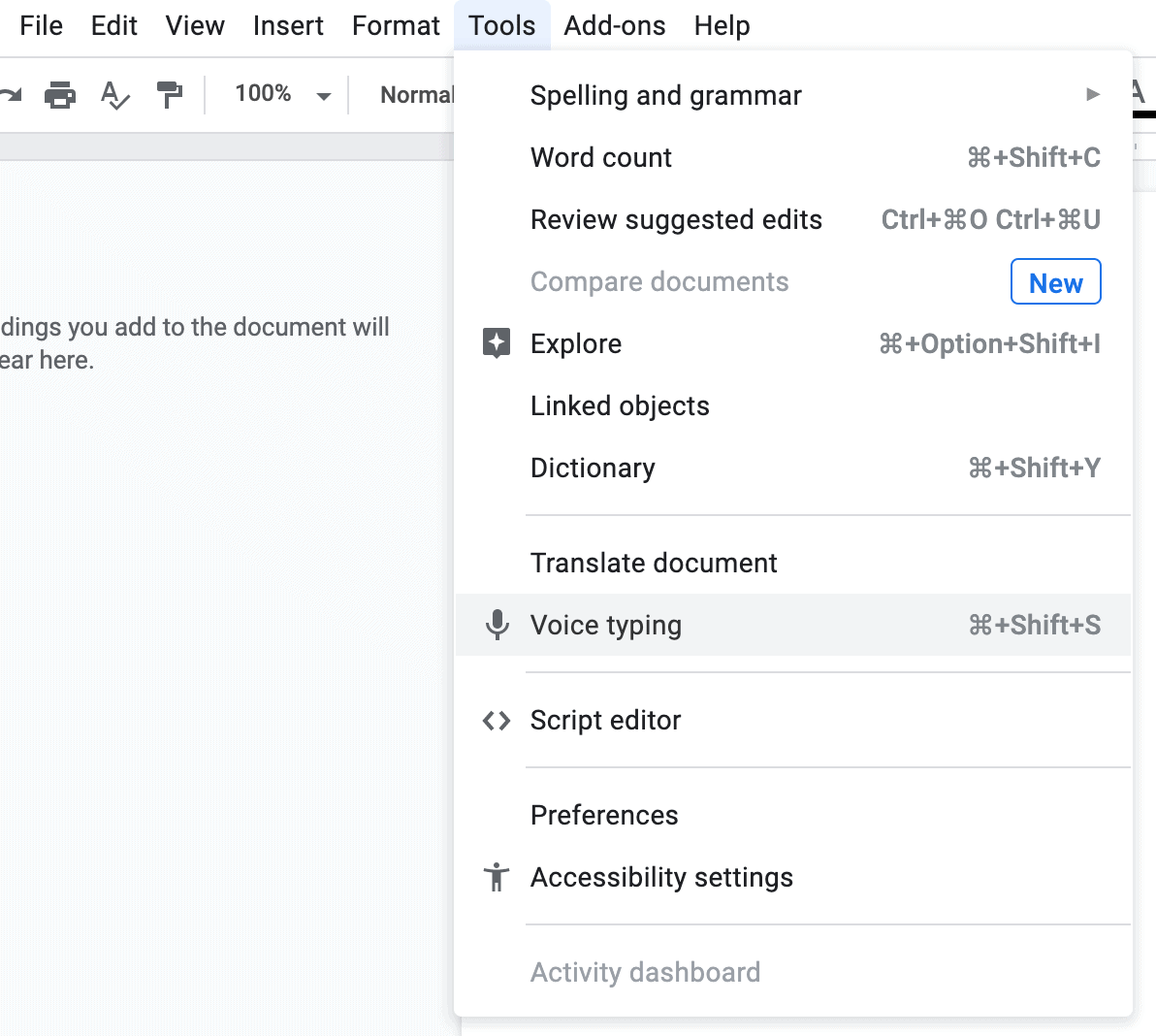
6. Use Google Docs Voice Typing
If you write your study notes online, then the voice typing tool in google docs will be an excellent study method for you!
This tool is available if you create a google document, click Tools, and then voice typing. Voice typing allows you your hands to rest and translates your speech into text.
The benefit of this for auditory learners is that you are verbally reinforcing the information by creating notes through speaking.
7. Record Lectures
Make sure to help yourself by recording any lectures you attend! This allows you to focus on listening to the lecture and taking notes later by listening to the recording.
Don’t forget to make a note of the topics each lecture teaches. This will be valuable in the studying stage! Whenever you need to clarify a specific topic, you can listen to a lecture recording that explained that topic.
You will feel as if you are in the classroom again and listening to this information will be the best way for you to process it.
8. Get a Tutor
If you are struggling a lot with studying, and are not confident about your knowledge, consider getting a tutor!
A tutor will help you as an auditory learner because you will learn conversationally and listen to them explain topics.
Also, they will be able to answer any of the questions you have! Listening to their answers will be valuable, as it will be easier for you to grasp and understand the information.
How do I Study Better as an Auditory Learner?
Start being more conscious of your studying habits and implementing methods aligned with your learning style. Help yourself in any way you can by trying out study methods that allow you to benefit from your listening skills.
It is easy to feel defeated when you fail your exams all because of unsuccessful studying.
New video, new guide, every Sunday
One short email with what we published that week, picked for adults going back to school.
More on study skills
All study skills guides
The Best Time Management Techniques to Tackle Any Task
Eight time management techniques explained with steps and examples, including Pareto, Pomodoro, the Eisenhower Matrix and time blocking.
8 min read

How To Make Your Online Classes Easier
Simple ways to make online classes easier, from setting up a study space and routine to apps that help with writing, notes and reading.
9 min read

Study Habits That Keep College Students Focused
Daily and study-session habits that help you stay focused in college without relying on coffee or energy drinks, plus apps that help.
6 min read