Free College Textbooks: 7 Legal Websites and Other Ways to Save
The best free textbook websites for college, all legal: OpenStax, LibreTexts, Open Textbook Library and more, plus library and used-book options.
 Written byJaviera VegaReviewed byGradehacker editors
Published September 8, 2021Updated November 22, 2026
Gradehacker is free to read. Some links in our guides may pay us a small commission if you sign up, at no cost to you. It does not change what we write. How we make money
Key points
- OpenStax, LibreTexts and the Open Textbook Library offer complete college textbooks you can read online or download as PDFs, free and legally.
- If your book comes from a regular publisher, check your college library, course reserves and interlibrary loan before you buy.
- Ask your professor if an older edition is fine, and compare used and rental prices by ISBN; they usually cost much less than new.
- We don't list sites that share paid textbooks without permission: using them breaks copyright law and they often carry malware.
On this page
The best free textbook websites for college are OpenStax, LibreTexts and the Open Textbook Library. All three offer complete college textbooks that you can read online or download as a PDF, for free and legally. For older books and novels, use Project Gutenberg and the Internet Archive’s Open Library.
If your class uses a book from a regular publisher, it usually won’t be free online. You can still borrow it, rent it or buy it used for much less than the bookstore price. This guide covers both: the free textbook websites first, then the other ways to pay less.
- OpenStax: best for general education courses like biology, psychology, algebra, economics and U.S. history, plus nursing
- LibreTexts: best for science, math and health sciences, with thousands of open textbooks
- Open Textbook Library: best for finding a free textbook in almost any college subject
- OASIS: best for searching many free textbook sites at once
- MERLOT: best for open textbooks plus practice materials and simulations
- Project Gutenberg: best for literature, history and philosophy classes that use older public domain books
- Internet Archive and Open Library: best for borrowing older or out-of-print books for free
About this video: our 2021 video walks through six places students used to find free textbooks. Two of them, Project Gutenberg and the Internet Archive, are still good legal choices and are covered below. Bookboon, another site in the video, now sells workplace training instead of free student textbooks. The other three sites in the video share copyrighted books without the publisher’s permission, so we no longer recommend them. This written guide replaces that list with legal options.
What Are the Best Free Textbook Websites?
The best free textbook websites publish open textbooks: complete college books that the authors have licensed for anyone to read, download and share at no cost. They are legal, safe to download and written or reviewed by college faculty.
Before you search, look at your syllabus. Many instructors now assign an open textbook on purpose, and the syllabus will often link straight to it.
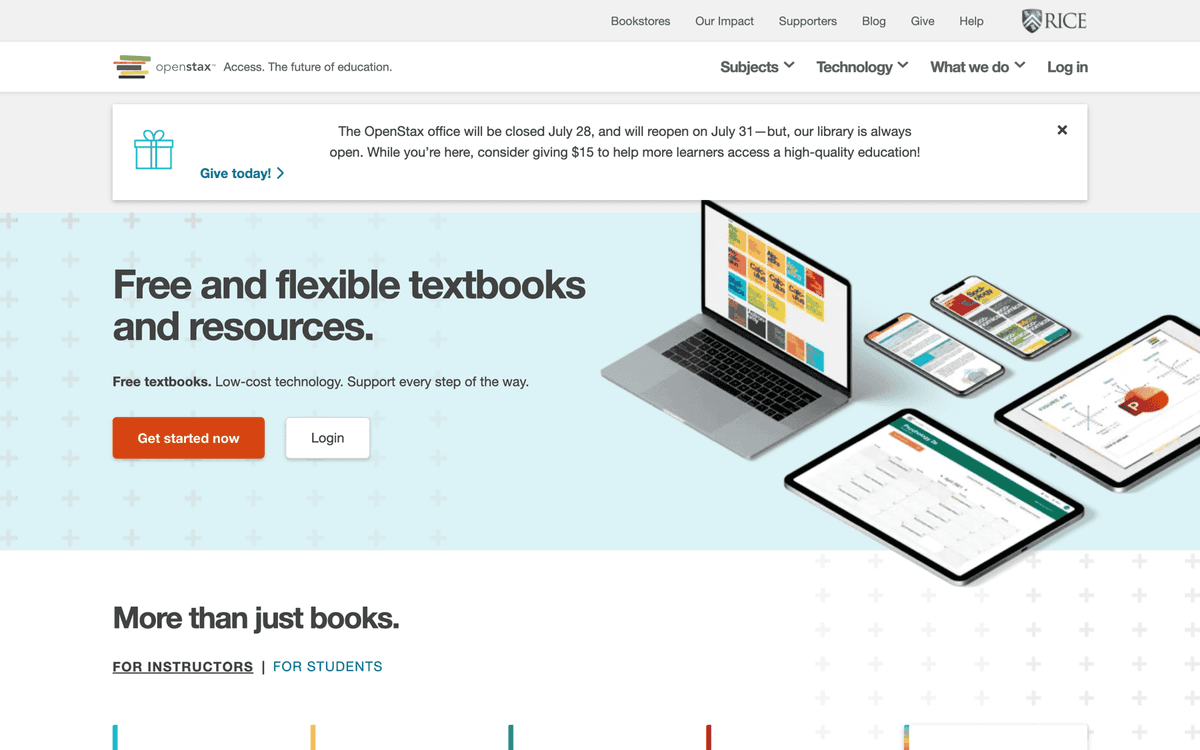
OpenStax
OpenStax is a nonprofit run by Rice University. Every book in its library is free to read online or download as a PDF, and the books are peer-reviewed by educators. You can also order a printed copy at a low cost if you prefer paper.
Its library covers the classes most adults take in their first years of college: Biology, Anatomy and Physiology, Chemistry, Psychology, Introduction to Sociology, American Government, U.S. History, College Algebra, Introductory Statistics, Principles of Economics, Accounting, Introduction to Business and a Writing Guide. It also has eight nursing books, including Fundamentals of Nursing, Pharmacology for Nurses and Medical-Surgical Nursing.
Good for: general education courses, community college students, business majors and nursing students. If your course title matches an OpenStax book, there is a good chance your instructor already uses it.
LibreTexts
LibreTexts is a nonprofit open education platform with thousands of open textbooks. They are organized into subject libraries such as Biology, Business, Chemistry, Engineering, Mathematics, Physics, Statistics, Social Sciences, Humanities and Health Sciences. Most books can be read online or downloaded as a full PDF.
Many colleges build their own versions of these books, so you may find the exact book your school uses under its “Campus Bookshelves.”
Good for: science and math courses, and allied health or nursing prerequisites through the Health Sciences library.
Open Textbook Library
The Open Textbook Library is run by the Open Education Network at the University of Minnesota. It lists about 1,900 open textbooks that you can download at no cost. Subjects include business, computer science, education, humanities, law, mathematics, medicine (including nursing and nutrition), natural sciences and social sciences.
Good for: finding a free book for a specific course when OpenStax doesn’t have one, and for education, law and humanities students.
OASIS
OASIS, from SUNY Geneseo’s Milne Library, is a search tool rather than a library. It searches more than 130 sources of free and open materials at once, with over 440,000 records, so you don’t have to check every site one by one.
Good for: anyone looking for a “textbook PDF finder” that only returns legal, free books. Search by subject or by the topic of your course.
MERLOT
MERLOT is a free collection of more than 110,000 online learning materials shared by educators, including about 9,500 open textbooks. Next to the books, you will find practice exercises, tutorials and simulations.
Good for: students who want extra practice materials alongside a free textbook, and adult learners filling gaps before a hard course.
Project Gutenberg
Project Gutenberg is an online library of more than 75,000 free eBooks, run by the Project Gutenberg Literary Archive Foundation. Its books are old enough to be in the public domain in the United States, so you can download and keep them legally.
It won’t have a modern chemistry or accounting textbook. It is the place to go when a literature, history or philosophy class assigns classic works like Shakespeare, Frederick Douglass or Plato. You can also watch our video on how to use Project Gutenberg.
Good for: English, literature, history and philosophy courses.
Internet Archive and Open Library
Open Library is run by the Internet Archive, a nonprofit. Once you sign up for an account, you can borrow up to ten digital books at a time for free. Loans last one hour for browsing, or 14 days when a book is fully borrowable, and they return themselves, so there are no late fees.
The Internet Archive’s lending library works the same way. Each copy can be borrowed by one person at a time, so popular books may have a waitlist.
Good for: older editions, out-of-print books and readings you only need for a few chapters.
How Do I Find a Free PDF of My Exact Textbook?
If your book is an open textbook, you can download the PDF free from the site that publishes it. If it comes from a commercial publisher, there is usually no legal free PDF, but you can often borrow it. Follow these steps in order:
- Check your syllabus or course page for a link. Open textbooks are often linked right there.
- Search the book title on OpenStax, LibreTexts and OASIS.
- Search your college library’s website for the title. Many libraries have an ebook version you can read with your student login.
- Ask the library if there is a copy on course reserve or if it can get one through interlibrary loan.
- If you still need to buy it, compare used, rental and older-edition prices by the book’s ISBN.
What If My Textbook Isn’t Free Online?
Your best options are your college library, an older or used copy, or a rental. Each one can save you a large part of the price of a new book.
Your college library and course reserves
Your college library is the first place to check. Many libraries buy ebooks that students can read for free with a student login, and many keep required textbooks “on reserve” for short loans. Online students can usually use the library’s ebooks from home.
Good for: online and part-time students who don’t live near campus, since ebooks work from anywhere.
Interlibrary loan
Interlibrary loan lets your library borrow a book from another library for you. Many college libraries offer it free to students. It can take days or weeks, so request early. You can see which libraries own a book on WorldCat. Your local public library can often do the same, which helps if you’re not on a campus.
Good for: books you only need for part of the term, and adult learners who already have a public library card.
Ask your professor about older editions
New editions often change little besides page numbers and practice problems. Email your professor and ask if an older edition is fine for the class. Older editions often cost a few dollars used. Some professors also have a copy you can borrow or can point you to a free alternative.
Good for: anyone, and it takes two minutes.
Rent or buy used
Renting or buying used is usually much cheaper than buying new. Compare your campus bookstore with online sellers such as AbeBooks by searching the ISBN on your syllabus, so you get the right edition. Check whether you need an access code for online homework first, because a used book won’t include one.
Good for: courses where you have to use the exact book, and books you want to keep for your major.
Publisher temporary access
If your class uses a publisher’s online platform, you may get temporary access at the start of the term before you pay. Cengage, for example, says temporary access may be available for some of its courses. Use that window to see how much you really need the book before you buy.
Good for: courses with online homework systems, where the access code is the real cost.
Inclusive access programs
Some colleges add digital textbooks to your tuition bill through “inclusive access” or similar programs. Under federal rules, a school that does this has to offer the books below market prices and let you opt out. Compare the charge with the price of a used or rented copy. If you can find the book cheaper or free, opt out before your school’s deadline.
Good for: students who want the book ready on day one. Check the cost first.
Why Don’t We List Sites That Share Paid Textbooks for Free?
Because using them is illegal and risky. Sites that post copyrighted textbooks without the publisher’s permission break copyright law, and downloading from them can break your school’s rules too. They are also a common source of malware: fake download buttons, files that aren’t really PDFs and pop-ups that ask for your login. An earlier version of this guide listed some of those sites. We removed them, and every site above is legal and free to use.
If cost is the real problem, talk to your school’s financial aid office. You can read more about how financial aid works and other ways to improve your college finances.
Free Textbook FAQs
What are the best free textbook websites?
OpenStax, LibreTexts and the Open Textbook Library are the best free textbook websites for college courses. Use OASIS to search many free sources at once, and Project Gutenberg or Open Library for older books.
Are websites for free textbooks legal?
The ones in this guide are. They publish open textbooks or public domain books, or they lend digital copies one reader at a time. A site that offers a new, paid textbook as a free download is almost always sharing it without permission.
Can I get free college textbooks as PDFs?
Yes, if the book is an open textbook. OpenStax, LibreTexts and the Open Textbook Library all offer free PDF downloads. Books from commercial publishers are not legally free as PDFs, but your library may let you read them as ebooks.
Is there a textbook PDF finder?
OASIS works like one for legal books. It searches more than 130 free and open sources at once. For a book from a commercial publisher, search your college library’s catalog instead.
Does financial aid pay for textbooks?
It can. Federal aid can count toward books and supplies, and if you expect a financial aid refund, federal rules require your school to give you a way to get your required books by the seventh day of the term. Ask your financial aid office how it works at your school. You can also compare digital and printed textbooks to see which one costs you less.
Is Bookboon still free?
Not for students in the way it used to be. When we checked in November 2026, Bookboon’s site offered paid professional training for workplaces, not free student textbooks, so we removed it from this list.
New video, new guide, every Sunday
One short email with what we published that week, picked for adults going back to school.
More on paying for school
All paying for school guides
Can Non-Traditional Students Get Financial Aid?
Yes, adult and non-traditional students can get financial aid. See which scholarships, college aid, federal aid and employer help you can use.
6 min read
Everything You Should Know About Financial Aid (FAFSA)
How the current FAFSA works: deadlines for 2026-27 and 2027-28, the Student Aid Index, who counts as independent, and the new Pell Grant rules.
21 min read
Best Scholarships for Non-Traditional Students: Find Yours!
Nine scholarships for non-traditional students, including awards for moms, single dads and returning women, with requirements, amounts and deadlines.
10 min read